13 Aug 2026 · Roadworthy
Will AI Take Over HGV Driving Jobs?
Will AI take over HGV driving jobs in the UK? We examine autonomous haulage tech, legal hurdles and why human drivers remain vital.
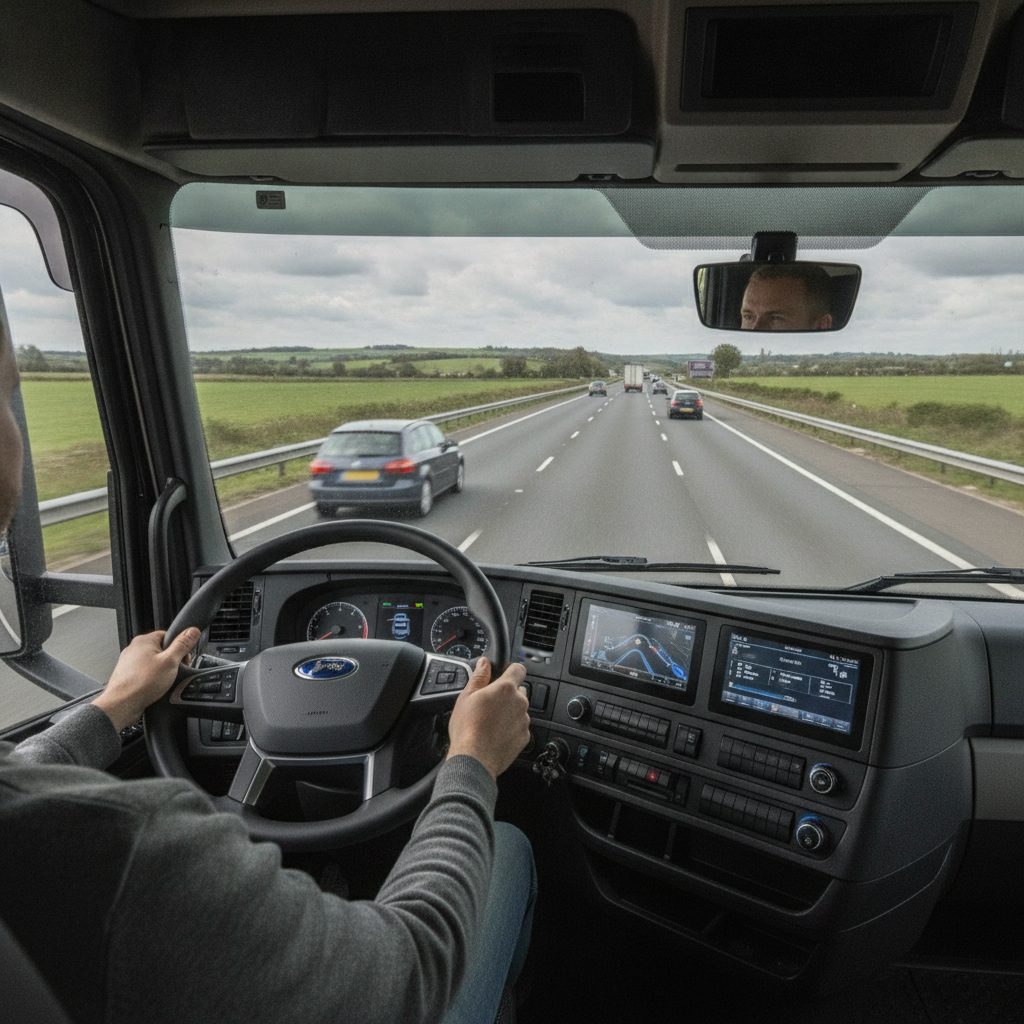
The Current State of Autonomous HGV Technology
Autonomous truck technology has developed rapidly over the past decade, driven by investments from silicon valley start-ups and established vehicle manufacturers. Systems are categorized across six levels of automation, ranging from Level 0, which relies entirely on human control, to Level 5, where a vehicle operates without human intervention in any environment. Most commercial trials currently focus on Level 4 autonomy, where a truck can drive itself under specific conditions, such as clear motorway stretches during daylight hours.
In regions with long, straightforward highway networks like the American Sunbelt, autonomous lorries carry freight between logistics hubs with minimal human supervision. However, transferring these systems to European infrastructure involves distinct technical hurdles. Haulage routes passing through busy freight ports such as those in Dover demand continuous management of heavy traffic, passport control queues, and variable lane configurations that confuse automated software sensors.
While computer vision, lidar, and radar systems process spatial data faster than human eyes, they rely on predictable environments. Machine learning models struggle when encountering unexpected road obstacles, poorly marked lanes, or conflicting instructions from human traffic controllers. As a result, autonomous technology remains largely confined to structured test programmes rather than widespread commercial deployment.
Why UK Road Networks Present Unique Challenges
The geography and infrastructure of the United Kingdom create an environment that is notoriously difficult for autonomous vehicle systems to interpret. Unlike grid-based North American cities or expansive interstates, British roads evolved over centuries from historic carriage tracks and rural lanes. Drivers routinely handle narrow dual-carriageways, tight mini-roundabouts, parked cars along urban streets, and low railway bridges.
Weather conditions across the British Isles add further complexity. Heavy rain, dense fog, spray from wet asphalt, and occasional snowfall can obscure lane markings and blind lidar optics. A human driver relies on years of experiential judgment to adapt speed and braking distances when roads freeze over or when high winds buffet high-sided vehicles. Automated systems struggle to duplicate this level of intuitive risk assessment when sensor data becomes degraded by grime or severe squalls.
Regional distribution networks also require vehicles to transition quickly between varied road types. An HGV carrying goods from a major maritime terminal near Hull may start its journey on a modern motorway, move onto a congested dual carriageway, and finish its delivery down an unclassified rural lane. While an AI algorithm might manage the motorway portion reasonably well, the final miles require human problem-solving skills that current technology cannot replicate.
The Essential Non-Driving Tasks of an HGV Driver
Focusing purely on steering and pedalling ignores the wide range of responsibilities that professional HGV drivers handle throughout their shifts. Being an HGV driver involves managing physical safety, regulatory compliance, customer communication, and emergency problem solving on the ground.
Before turning the key, a driver performs crucial daily walkaround inspections. They check tyre pressure, examine air hoses for leaks, ensure light clusters function, and confirm that wheel nuts are secure. Once loaded, the driver is legally responsible for verifying load security. Strapping down timber, securing steel coils, or checking temperature controls on refrigerated trailers requires physical labor and practical knowledge that a computer program cannot perform.
- Coupling and uncoupling trailers: Connecting fifth-wheel couplings, attaching suzie cables, and adjusting landing legs.
- Cargo inspections: Checking load distribution to prevent axle overload and re-securing shifted pallets during transit.
- Depot maneuvers: Reversing articulated vehicles into tight loading bays surrounded by pedestrians, forklifts, and staging equipment.
- Customs and documentation: Handling consignment notes, hazardous materials paperwork, and border clearance protocols.
- Client interaction: Acting as the physical face of the logistics firm when handing over goods to site managers or warehouse supervisors.
If a tyre bursts or a mechanical fault develops in transit, a human driver identifies the issue, guides the vehicle safely onto a hard shoulder, sets up warning markers, and coordinates with recovery services. An autonomous vehicle encountering a mechanical fault can quickly become an immovable hazard, blocking critical freight corridors until human support arrives.
Legal, Safety, and Insurance Barriers
Even if the technology reaches full reliability, legal and regulatory frameworks present massive hurdles to driverless freight. In the UK, traffic law requires a legal entity to be accountable for vehicle operation. Establishing clear fault in collisions involving autonomous vehicles requires complex legislation that balances software developer liability, vehicle manufacturer accountability, and fleet operator responsibility.
Insurance structures for 44-tonne commercial vehicles present another major hurdle. Insurers calculate risk based on decades of human driving statistics. Assigning risk profiles to proprietary neural networks and unproven software updates requires fundamentally new underwriting models. A single high-profile collision caused by a software glitch could stall public acceptance and regulatory approval for years.
Cybersecurity is an equally urgent consideration. Connected autonomous vehicles represent potential targets for malicious hackers, ransomware attacks, or system outages. Commercial fleets carrying fuel, chemicals, or valuable cargo must be protected against remote intervention, creating a massive ongoing maintenance burden for transport operators.
How AI Is Already Assisting HGV Drivers
Rather than replacing human drivers outright, artificial intelligence is transforming the cab environment into a safer, more efficient workplace. Advanced Driver Assistance Systems (ADAS) use predictive algorithms to assist drivers with routine operations, reducing fatigue on long-haul journeys across distribution centers, such as those found around Andover.
Modern haulage fleets use intelligent telematics to optimize fuel consumption and plan efficient delivery routes around real-time traffic jams. Predictive cruise control uses GPS topographical data to anticipate upcoming hills, lowering gear choices and adjusting engine torque to save diesel or battery charge. Emergency braking systems constantly monitor forward blind spots, intervening to avoid collisions if a car pulls out unexpectedly.
Inside the cab, camera-based driver monitoring systems watch for signs of distraction or drowsiness, alerting the operator before an accident occurs. Modern tools provided by platforms like Rwapp also help incoming drivers prepare for their initial licensing exams, using digital learning systems to master complex hazard perception skills and CPC compliance rules before taking the wheel.
Comparing Autonomous Systems and Human Drivers
To understand why complete replacement of commercial drivers remains unlikely in the medium term, it helps to compare how software and humans handle different logistics operational requirements.
| Operational Aspect | Autonomous Freight Systems | Human HGV Drivers |
|---|---|---|
| Motorway Cruising | Highly efficient, consistent speed, precise lane keeping. | Prone to fatigue, requires mandatory rest breaks. |
| Severe Weather Handling | Sensor optics degrade in heavy rain, spray, or snow. | Adapts driving style based on road feel and experience. |
| Urban & Last-Mile Delivery | Struggles with roadworks, parked cars, and pedestrians. | Manoeuvres safely through tight, dynamic environments. |
| Cargo Handling & Security | Cannot strap loads, perform walkarounds, or check seals. | Manually verifies load stability and performs safety checks. |
| Legal Liability | Unresolved regulatory frameworks and software accountability. | Clear legal responsibility under existing road traffic acts. |
The Future Timeline and Career Outlook
The consensus among transport planners, vehicle manufacturers, and logistics economists is that AI will augment human drivers rather than render them obsolete over the next 15 to 25 years. The shift will resemble the evolution of commercial aviation, where autopilot handles cruising at high altitude while pilots manage takeoff, landing, complex weather, and unexpected emergencies.
One likely intermediate step is middle-mile platooning. In this scenario, a human-driven HGV leads a convoy of two or three closely following automated trucks along designated motorway corridors. Once the convoy reaches a regional hub, human drivers take over individual lorries to complete the final, complex legs of delivery to local stores and industrial estates.
For those entering the transport industry today, HGV driving remains a stable, resilient career choice. Demand for skilled drivers across the UK continues to outstrip supply, driven by expanding e-commerce networks and retiring workforce cohorts. Rather than fearing automation, upcoming drivers can expect to work alongside intelligent safety technologies that make the job less physically demanding, safer, and more comfortable.
Run your whole driving school from your phone.
Get early access