5 Aug 2026 · Roadworthy
What are learner drivers not allowed to do in the UK?
Find out what learner drivers are not allowed to do on UK roads, including motorway rules, supervision laws, and key penalties.
Driving without proper supervision
A learner driver with a provisional licence is strictly forbidden from driving a car on public roads without appropriate supervision. The person supervising you must meet specific criteria set out in UK law. They must be at least 21 years old and must have held a full UK or European Economic Area driving licence for at least three full years for the type of vehicle you are driving. If you are learning in a manual car, your supervisor must hold a full manual licence.
The law treats the supervisor as the person in legal charge of the vehicle. This means your supervisor cannot sit in the back seat, read a book, sleep, or supervise you while under the influence of alcohol or drugs. The alcohol limit for the supervisor is identical to the legal limit for a driver. If you drive without a legal supervisor, you commit a serious motoring offence punishable by up to six penalty points and a fine of up to £1,000.
When taking lessons with a friend or family member outside of professional instruction, ensure they meet all legal criteria before turning the key. Whether you are practising in town centres or learning with private instructors in Nottingham, valid supervision is mandatory every second the engine is running.
Motorway driving restrictions
Learner drivers are not allowed on motorways in England, Scotland, and Wales unless specific strict conditions are met. You can only drive on a motorway if you are accompanied by an Approved Driving Instructor in a vehicle fitted with dual controls. Trainee driving instructors, who have not yet passed their final qualifying exams, are not legally permitted to take learner drivers onto motorways.
Practising motorway driving with family or friends is entirely illegal, even if your supervisor is over 21 and has decades of driving experience. For instance, pupils taking lessons in Fareham must only join the nearby M27 if accompanied by a fully qualified instructor in a dual-controlled car. Joining a motorway under any other condition carries a fine of up to £1,000 and three penalty points.
In Northern Ireland, rules differ further. Learner drivers are completely banned from driving on motorways under all circumstances, regardless of whether an approved instructor is present in the car.
L plate display and placement
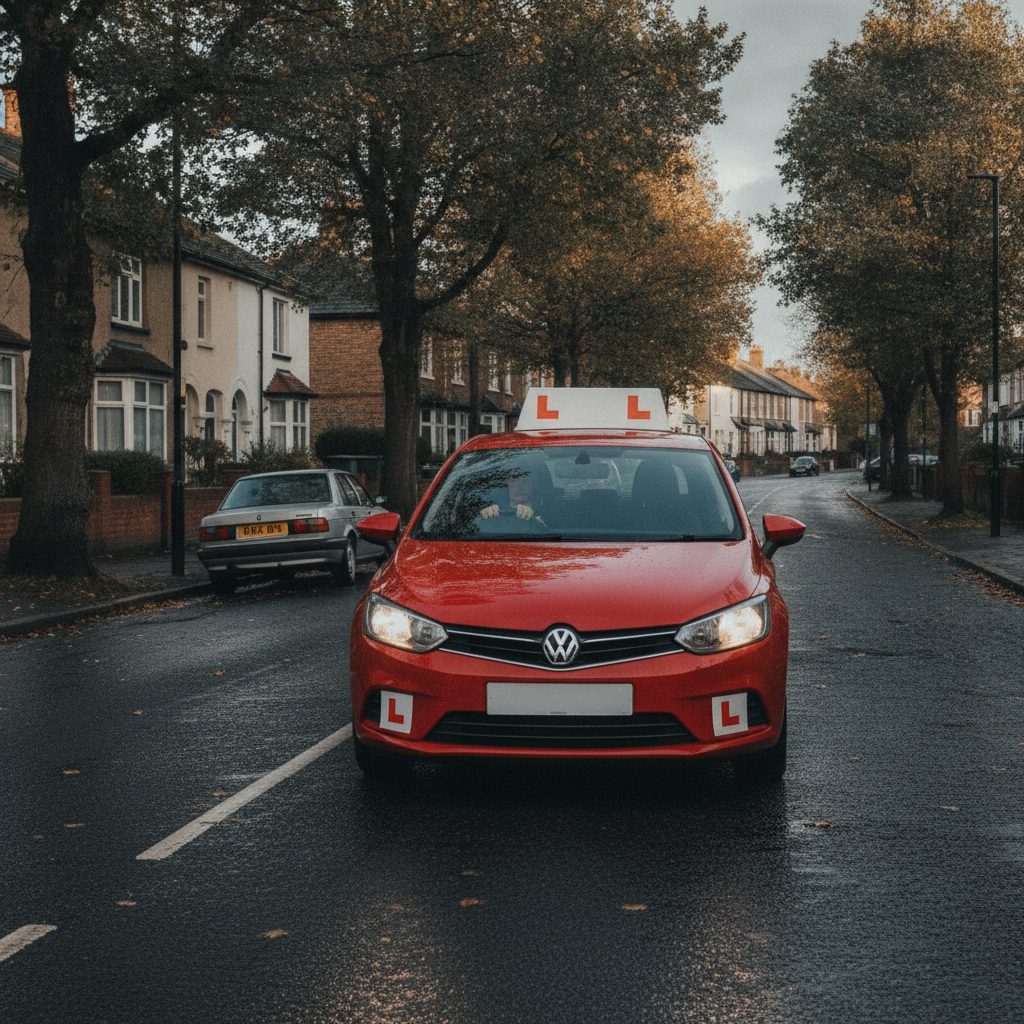
Learner drivers are not permitted to drive on public roads without displaying official red L plates on the front and rear of the vehicle. In Wales, drivers may use D plates, L plates, or both. The plates must be clearly visible to other road users from both the front and back of the car.
The standard size and design of L plates are strictly regulated by law. You cannot use makeshift paper signs or damaged plates where the red letter L is faded or altered. The background must be white, and the letter must meet exact height and width specifications set by the Driver and Vehicle Standards Agency. Placing an L plate behind a tinted rear window where it cannot be easily read is also a violation.
Furthermore, when a qualified driver takes over and drives the vehicle without a learner present, those L plates should be removed or covered over. Failing to display standard L plates while driving as a learner can land you up to six penalty points and a fine of up to £1,000.
Carrying passengers and towing trailers
Many learner drivers assume that carrying friends or family members as passengers is illegal, but that is not the case. Learner drivers are legally allowed to carry passengers of any age, provided the total number of occupants does not exceed the legal seating capacity of the vehicle, and everyone uses a seatbelt.
However, you cannot carry passengers unless your legal supervisor is sitting in the front passenger seat next to you. The passengers in the rear seats must not distract you or interfere with your control of the car. If carrying passengers causes a distraction that leads to unsafe driving, you can be charged with driving without due care and attention.
Towing is another area with strict rules. Learner drivers holding a provisional category B licence are not permitted to tow a trailer or caravan on public roads unless they are taking an official test or holding a specific entitlement. Attempting to tow heavy loads without the required licence category exposes the driver to immediate prosecution.
Mobile phone and technology rules
Using a hand-held mobile phone while driving is strictly prohibited for all drivers, including learners. You cannot hold a phone to make calls, send texts, check maps, or scroll through playlists while driving, even when stopped at traffic lights or idling in traffic queues.
The rule extends directly to the supervising passenger. Because the supervisor is legally responsible for the control of the car, they are not allowed to use a hand-held mobile phone while supervising a learner. If your passenger supervisor uses their phone while you are driving, they can receive six penalty points and a fine of £200.
Hands-free systems and satellite navigation screens must be set up before you start your journey. Driving instructors who track pupil progress using digital systems or tools like voice notes must only record feedback while the vehicle is safely parked with the engine switched off.
Insurance and vehicle legality
Learner drivers are not permitted to drive any vehicle without specific provisional driver insurance coverage. Standard fully comprehensive insurance policies held by parents or partners do not automatically cover a learner driver unless the learner is explicitly named on the policy or holds a dedicated temporary learner insurance policy.
The car being driven must also meet every standard legal requirement. It must be taxed, have a valid MOT certificate if over three years old, and be fully roadworthy. Check tyres, mirrors, brakes, and headlights before every journey.
Driving an uninsured vehicle as a learner carries severe penalties. You face an unlimited fine, six to eight penalty points, and potential seizure of the vehicle by the police. Because six penalty points will instantly revoke a full licence within your first two years of passing, accumulating points as a learner can derail your driving plans before you get started. Preparing for test success with professional support from platforms like Rwapp helps learners stay compliant with road laws and build safe habits early.
Summary of learner driver rules and penalties
The table below outlines key activities learner drivers are not allowed to do, along with the statutory penalties for breaking each law.
| Restricted Activity | Legal Requirement | Maximum Penalty |
|---|---|---|
| Driving unsupervised | Must be accompanied by a qualified driver aged 21+ with 3 years licence history | Fine up to £1,000 and 6 penalty points |
| Motorway driving (GB) | Only allowed with an ADI in a dual-controlled vehicle | Fine up to £1,000 and 3 penalty points |
| Motorway driving (NI) | Banned under all circumstances | Fine up to £1,000 and penalty points |
| Driving without L plates | Must display standard red L (or D in Wales) plates front and rear | Fine up to £1,000 and up to 6 penalty points |
| Driving without insurance | Must have specific provisional insurance cover | Unlimited fine and 6 to 8 penalty points |
| Supervisor using phone | Supervisor cannot use hand-held phone while supervising | £200 fine and 6 penalty points for supervisor |
Run your whole driving school from your phone.
Get early access